HSK Test Format by Level: Questions, Sections and Timing
 HSK FORMAT GUIDE
The HSK test format changes as you move through the levels, from Listening and Reading at HSK 1 to Writing, Translation and Speaking in the combined HSK 7–9 exam.
But the number of questions does not simply increase from one level to the next. HSK 4 and HSK 5, for example, both contain 100 questions, yet HSK 5 gives you considerably more time because the Reading and Writing tasks are more demanding.
This guide compares the current HSK test format by level, including:
The sections included at each HSK level
The number of questions or tasks
Approximate test time
The main skills assessed
Paper-based vs computer-based HSK
When Speaking becomes part of the test
First, check which HSK format you are taking
Most regular HSK Levels 1–6 test dates in 2026 still use the current format described in this guide. HSK 3.0 is being introduced through specifically announced trial sessions and uses a different syllabus, revised question formats and different speaking requirements.
Before choosing a vocabulary list, textbook or mock test, check the exact test name and format shown on your registration.
This article focuses mainly on the current HSK Levels 1–6 format and also explains the combined advanced HSK 7–9 exam.
HSK test format comparison
| HSK level | Test sections | Questions / tasks | Approx. total time |
|---|---|---|---|
| HSK Level 1 | Listening and Reading | 40 | 40 minutes |
| HSK Level 2 | Listening and Reading | 60 | 55 minutes |
| HSK Level 3 | Listening, Reading and Writing | 80 | 90 minutes |
| HSK Level 4 | Listening, Reading and Writing | 100 | 105 minutes |
| HSK Level 5 | Listening, Reading and Writing | 100 | 125 minutes |
| HSK Level 6 | Listening, Reading and Writing | 101 | 140 minutes |
| HSK Levels 7–9 | Listening, Reading, Writing, Translation and Speaking | 98 | About 210 minutes |
For HSK Levels 1–6, the published total duration includes about five minutes for candidates to enter their personal information. Paper-based tests also include time after the Listening section to transfer answers to the answer sheet.
HSK Levels 7–9 use one combined advanced exam. You do not choose a separate Level 7, Level 8 or Level 9 paper before the test; your final result determines the level awarded.
HSK Level 1 test format
HSK Level 1 is the shortest current HSK exam and contains two sections: Listening and Reading.
| Section | Parts | Questions | Approx. time |
|---|---|---|---|
| Listening | 4 | 20 | 15 minutes |
| Reading | 4 | 20 | 17 minutes |
| Answer transfer | — | — | 3 minutes |
| Total | 8 | 40 | About 40 minutes, including personal information |
The Listening section checks whether you can recognise familiar words, understand short statements and follow very simple dialogues.
The Reading section uses short sentences, pictures and matching tasks. There is no Writing section, but you still need to recognise the Chinese characters used in the questions and answers.
HSK Level 2 test format
HSK Level 2 still focuses on Listening and Reading, but the test contains more questions and longer spoken exchanges.
| Section | Parts | Questions | Approx. time |
|---|---|---|---|
| Listening | 4 | 35 | 25 minutes |
| Reading | 4 | 25 | 22 minutes |
| Answer transfer | — | — | 3 minutes |
| Total | 8 | 60 | About 55 minutes, including personal information |
You need to understand short everyday conversations, identify key details and connect spoken or written information with the correct picture, sentence or response.
There is still no Writing section at HSK Level 2. You need to read Chinese characters, but you do not have to produce written Chinese in the exam.
HSK Level 3 test format
HSK Level 3 is the first level in the current format to include a Writing section.
| Section | Parts | Questions | Approx. time |
|---|---|---|---|
| Listening | 4 | 40 | 35 minutes |
| Reading | 3 | 30 | 30 minutes |
| Writing | 2 | 10 | 15 minutes |
| Answer transfer | — | — | 5 minutes |
| Total | 9 | 80 | About 90 minutes, including personal information |
Listening includes short dialogues and longer spoken passages. You need to identify details, understand the situation and choose the best answer.
Reading tests sentence matching, gap filling and comprehension of short passages.
Writing checks whether you can arrange words into correct Chinese sentences and write the required Chinese character from the information provided.
HSK Level 4 test format
HSK Level 4 contains 100 questions across Listening, Reading and Writing.
| Section | Parts | Questions | Approx. time |
|---|---|---|---|
| Listening | 3 | 45 | 30 minutes |
| Reading | 3 | 40 | 40 minutes |
| Writing | 2 | 15 | 25 minutes |
| Answer transfer | — | — | 5 minutes |
| Total | 8 | 100 | About 105 minutes, including personal information |
The Listening material is longer and requires you to follow conversations, understand relationships between speakers and recognise what a speaker means rather than relying on isolated words.
Reading includes sentence ordering, gap filling and longer passages, so reading speed becomes more important than at HSK Level 3.
Writing tests sentence construction and your ability to produce complete Chinese sentences from the information given.
HSK Level 5 test format
HSK Level 5 also contains 100 questions, but it is longer than HSK Level 4 because the Reading and Writing tasks require more time.
| Section | Parts | Questions | Approx. time |
|---|---|---|---|
| Listening | 2 | 45 | 30 minutes |
| Reading | 3 | 45 | 45 minutes |
| Writing | 2 | 10 | 40 minutes |
| Answer transfer | — | — | 5 minutes |
| Total | 7 | 100 | About 125 minutes, including personal information |
Listening tests detailed understanding of longer dialogues and spoken passages. Questions may require you to identify viewpoints, reasons, relationships and conclusions.
Reading includes gap filling and comprehension of longer, connected texts.
Writing combines sentence-building questions with two short writing tasks: one based on a set of required words and one based on a picture.
HSK Level 6 test format
HSK Level 6 is the highest level in the current six-level system. The exam contains 101 questions or tasks across Listening, Reading and Writing.
| Section | Parts | Questions / tasks | Approx. time |
|---|---|---|---|
| Listening | 3 | 50 | 35 minutes |
| Reading | 4 | 50 | 50 minutes |
| Writing | 1 | 1 | 45 minutes |
| Answer transfer | — | — | 5 minutes |
| Total | 8 | 101 | About 140 minutes, including personal information |
Listening includes statements, interviews, conversations and longer informational passages delivered at a more natural pace.
Reading tests grammar accuracy, vocabulary in context, gap filling and detailed comprehension of longer texts.
The Writing section contains one extended summary task. You first read a Chinese text; the original is then removed and you write a summary without adding your own opinion.
HSK Levels 7–9 test format
HSK Levels 7–9 are assessed through one combined advanced exam. Candidates do not choose a separate Level 7, Level 8 or Level 9 test paper.
Your performance determines whether the final result is below Level 7, Level 7, Level 8 or Level 9.
| Section | Parts | Questions / tasks | Approx. time |
|---|---|---|---|
| Listening | 3 | 40 | 30 minutes |
| Reading | 3 | 47 | 60 minutes |
| Writing | 2 | 2 | 55 minutes |
| Translation | 2 | 4 | 41 minutes |
| Speaking | 3 | 5 | 24 minutes |
| Total | 13 | 98 | About 210 minutes |
The advanced exam covers a much wider range of material, including news, academic texts, business discussions, speeches, Chinese culture and social issues.
Writing includes graph or chart analysis and extended opinion writing.
Translation assesses your ability to translate into Chinese in both written and spoken form.
Speaking includes retelling, responding to content and presenting a structured viewpoint.
HSK Levels 7–9 are currently delivered as a computer-based test.
How does the HSK test format change by level?
The HSK format develops in four clear stages.
HSK Levels 1–2: Listening and Reading
The first two levels assess receptive skills. You listen to basic spoken Chinese and read short sentences, but there is no Writing section.
HSK Levels 3–4: Writing is introduced
Writing begins at HSK Level 3. From this point, recognising the correct answer is no longer enough: you also need to produce correctly structured Chinese sentences.
At HSK Level 4, the language becomes longer and more complex, and reading speed and time management start to matter much more.
HSK Levels 5–6: Longer texts and more independent production
HSK Level 5 introduces longer reading passages and short writing tasks.
HSK Level 6 requires you to process advanced spoken and written Chinese quickly and complete an extended summary task.
HSK Levels 7–9: Integrated advanced skills
The combined advanced exam assesses five skills: Listening, Reading, Writing, Translation and Speaking.
Candidates need to understand complex information, organise arguments, translate into Chinese and express ideas clearly in spoken form.
Paper-based HSK vs computer-based HSK
HSK Levels 1–6 may be offered in paper-based or computer-based format depending on the test date and test centre.
The core sections and level remain the same, but the way you answer is different.
Paper-based HSK
In a paper-based test, you mark your answers on an answer sheet. The published schedule includes additional time after Listening for transferring answers.
Writing tasks are completed by hand, so character recall, handwriting speed and legibility matter.
Computer-based HSK
In a computer-based test, answers are entered on a computer and the exam system manages the audio, section timing and submission.
At levels with Writing, you type answers using a Chinese input method. It is worth practising Chinese typing before test day rather than relying only on handwriting practice.
A computer-based HSK is still normally taken under supervision at an authorised test centre unless the registration information explicitly states otherwise.
Does the HSK test include Speaking?
Speaking is not part of the current HSK Levels 1–6 written exams described above.
HSK Speaking, known as HSKK, is a separate assessment with three levels: Basic, Intermediate and Advanced. Responses are recorded rather than given in a face-to-face interview.
A test centre, university, scholarship programme or registration rule may require HSKK alongside the written HSK. Always check the full registration requirements rather than assuming the written test is the only exam you need.
HSK Levels 7–9 are different: Speaking is integrated directly into the combined advanced exam as one of its five tested skills.
How to prepare for the HSK test format
Vocabulary and grammar matter, but exam performance also depends on whether you can use that knowledge within the real HSK structure and time limits.
Know the order of the sectionsUnderstand which section comes first, how many parts it contains and how much time you have. That removes unnecessary surprises on test day.
Practise the question types used at your levelGeneral Chinese exercises are useful, but they are not a substitute for practising the Listening, Reading and Writing question formats you will actually meet.
Work within the real time limitsComplete sections without pausing. You need to know whether you can maintain focus and accuracy for the full length of your exam.
Take a complete timed HSK mock testA full mock test shows how vocabulary, grammar, comprehension, writing and time management work together across the entire exam.
Practise the full HSK test format online
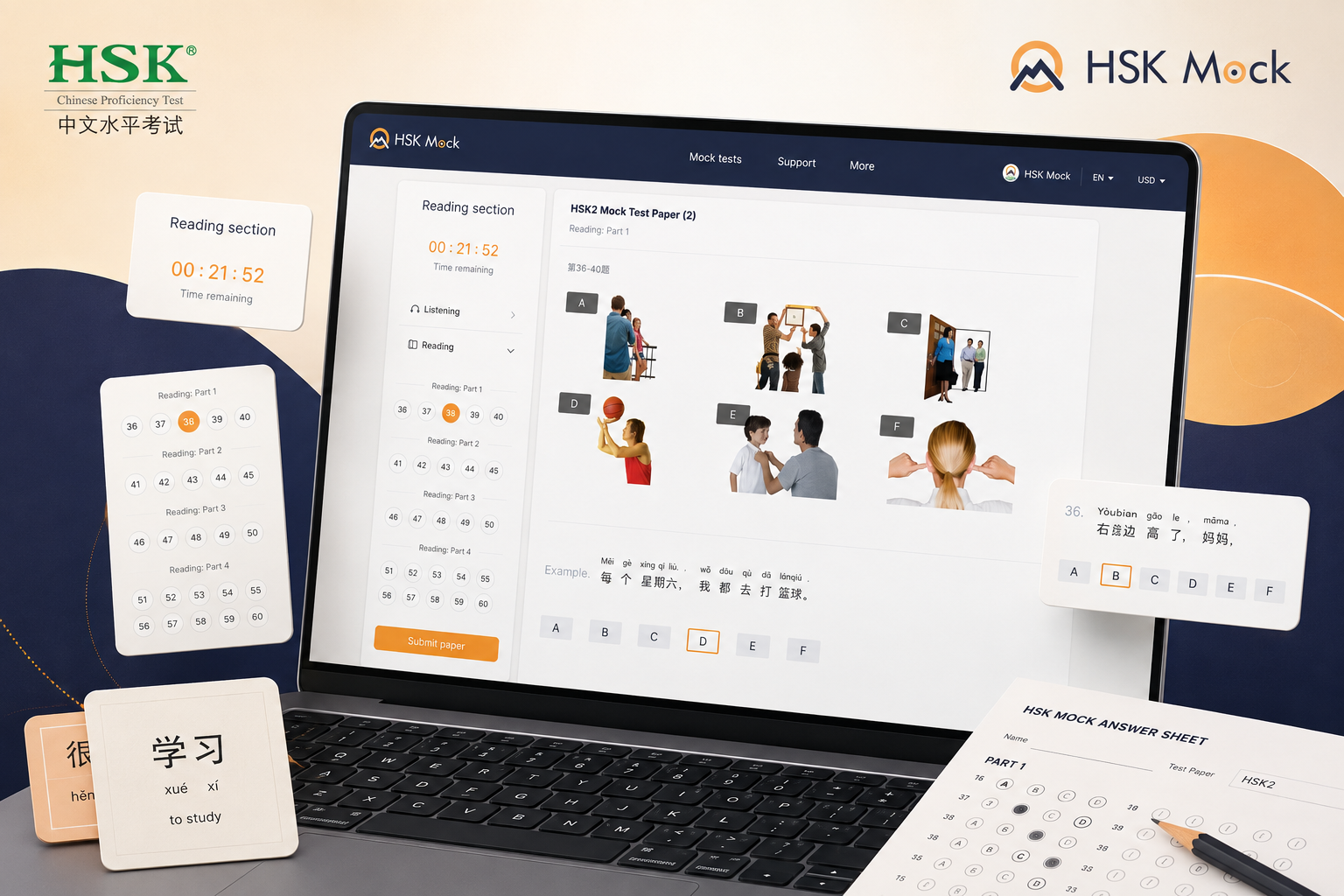
HSK Mock lets you work through a complete test from beginning to end using real past exam questions, realistic HSK timing and scoring based on official HSK standards.
Choose your HSK level
Practise the complete test structure
Experience realistic section timing
Identify weaker skills and question types
Review your results after completing the test
Practise on the web or mobile app
Frequently asked questions about the HSK test format
How many sections are in the HSK test?
HSK Levels 1 and 2 have two sections: Listening and Reading. HSK Levels 3–6 have three: Listening, Reading and Writing. HSK Levels 7–9 have five: Listening, Reading, Writing, Translation and Speaking.
How many questions are in the HSK?
The number depends on the level: HSK 1 has 40 questions, HSK 2 has 60, HSK 3 has 80, HSK 4 has 100, HSK 5 has 100, HSK 6 has 101 questions or tasks, and the combined HSK 7–9 exam has 98 questions or tasks.
How long is the HSK test?
Total test time ranges from about 40 minutes for HSK Level 1 to about 210 minutes for HSK Levels 7–9. Exact test-day timing may vary slightly depending on the format and procedures used by the test centre.
Which HSK level starts Writing?
In the current HSK format, Writing begins at HSK Level 3. HSK Levels 1 and 2 assess Listening and Reading only.
Is HSK Level 5 longer than HSK Level 4?
Yes. Both exams contain 100 questions, but HSK Level 5 lasts about 125 minutes compared with about 105 minutes for HSK Level 4. The extra time reflects the longer Reading section and more demanding Writing tasks.
Is HSK Level 6 the highest HSK level?
HSK Level 6 is the highest level in the current six-level system. HSK Levels 7–9 are assessed through a separate combined advanced exam that adds Translation and Speaking to Listening, Reading and Writing.
Are paper-based and computer-based HSK tests the same?
They assess the same level and core skills, but the response method differs. Paper-based candidates mark or write answers on paper, while computer-based candidates enter answers on a computer and type Writing responses using a Chinese input method.
Does HSK include a Speaking test?
The current HSK Levels 1–6 written exams do not include Speaking; speaking is assessed separately through HSKK. Speaking is integrated directly into the combined HSK Levels 7–9 exam.
Choose your HSK level and start practising
The HSK becomes longer and more demanding as you move through the levels, but preparation is much easier when you know exactly what each section expects from you.
Confirm the format you registered for, review the question types at your level and complete at least one full timed mock test before exam day.
View all HSK mock tests
